AI mentions in children’s stories up by 50 per cent
 by Educate Magazine March 2, 2026 · Education News / Latest Features / Primary School News / Technology
New research by Oxford University Press (OUP) of children’s creative writing in the BBC 500 Words competition highlights a shift in how young people are writing about AI. Despite the influence of technology, the report reveals libraries, and different forms of reading, still capture their imagination. OUP analysed over 46,500 stories stories by UK children aged 5-11 submitted to BBC 500 Words competition in the autumn of 2025.
BBC 500 Words is a children’s writing competition, run by BBC Bitesize in partnership with The One Show. The competition invites children aged 5-11 to submit an original story of up to 500 words. The competition is open to children of all abilities. It celebrates creativity and imagination, with entries judged anonymously and spelling, punctuation and grammar not marked. 500 Words champions young voices from all backgrounds.
A shift in writing about AI and the impact of screens
Mentions of AI increased 50 per cent in the last year. In 2020, AI appeared mostly in children’s stories in relation to an assistant or robot. By 2023, children often associated it with a dangerous entity. In 2025, whilst children still express concern, there is an increase in AI becoming an everyday feature in daily life or an imagined future. ChatGPT frequently appears as a character or narrator in children’s stories.
““Ugh! I’m so fed up with people asking me these dumb questions!” said ChatGPT, frowning.” (AI VS HUMANS, boy, age 10)
Relationships with screens also feature heavily in stories, with children showing concern about too much time spent on their phones. ‘Doomscrolling’ appears for the first time in writing and references to ‘brainrot’ jumped from one to 210 in the past year.
“Mason came to the understanding that there was one thing that AI would always not be able to replace: the human heart.” (The One Thing AI Could Not Replace, boy, age 10)
“cheetara gets brainrot instantly starts doomscrolling tiktok for 7 hours straight” (CHEETARA THE CAT!, boy, age 10)
Gaming influencing change in vocabulary
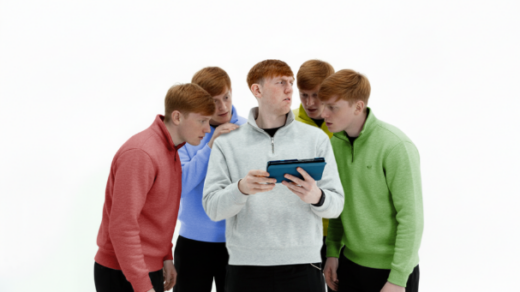
Gaming and social media also influenced vocabulary. Mentions of ‘dandy’ increased by over seven times, inspired by the Roblox virtual universe. Viral trend ‘six-seven’ appeared in stories, with the numbers occurring in their various forms, more than 400 times. ‘Tablet’ mentions also increased by 33 per cent in the last year. In 2025, most children described a ‘tablet’ as a device, whereas a decade earlier they mainly used the word to refer to medicine.
Andrea Quincey, director early years and primary publishing, Oxford University Press, said:
“Every story written for BBC 500 Words is added to our Oxford Children’s Corpus, one of the world’s largest databases of children’s written English. It’s been fascinating to analyse the brilliant stories children have submitted over the decade and track the creative ways they are using language. The BBC 500 Words competition is a hugely valuable initiative which contributes to one of the nation’s largest bodies of ongoing research into children’s language. This research is integral to understanding how children use language to engage with and reflect upon the world around them.”
Libraries capture children’s imagination
Mentions of ‘library’ in children’s writing increased over 100 per cent in the last decade. Usage of the word ‘library’ was similar across time with references to local and public libraries as well as ‘dusty’, ‘haunted’ and ‘magic’ libraries.
“Suddenly the hole libary woke up. Story books flapped like parrots, comic books giggled so hard they fell off the shelfs, and a pile of history books marched like solders shouting dates like “1066!”” (THE LIBARY THAT ATE MY HOMEWORK, girl, age 7)
Most book-related references are to printed books with minimal mentions of digital reading. References to ‘kindle’ dropped more than 70 per cent over the last decade. Traditional stories continued to capture children’s imagination. Cinderella and Snow White were both in the top ten fictional characters children wrote about.
“She flitted through the aisles, each book whispering another marvel to her. Every book carried a story. Then, she spotted it. A dust-covered book. It pulsed faintly, like a baby’s heartbeat.” (THE LEGEND OF THE LOST LIBRARY, girl, age 8)
Sarah Mears, programmes director at Libraries Connected, said:
“We are so excited to know that children are increasingly mentioning libraries and librarians in their 500 Words stories. Reading sparks children’s creativity and nurtures their empathy, both crucial life skills. Children enjoy reading most when they have free choice, a wide range of titles to select from and adults to support and guide them. That’s why public and school libraries and librarians are vital, and it is a true joy to know that children are recognising this in their stories.”
Challenging assumptions of sport and trending popular culture
In other key findings, ‘football’ mentions declined 25 per cent in the last year. This is the first time it has dropped in five years. References to ‘rugby’ increased by 50 per cent since 2024. Stories by girls challenged the assumption it was a game for boys.
“And she became Head Girl, her dream had come true. The first thing she did was make all the sports equal for the girls and boys – no more rugby for boys and hockey for girls.” (ONE BRAVE VOICE, girl, age 9)
“Sorry, I forgot to introduce myself, I’m Georgina Rose, a phenomenal rugby player and also, unfortunately, a princess.” (WILDCARD, girl, age 10)
‘Lego’ remained a top mentioned toy and ‘Labubu’ appeared for the first time in stories. Popular TV series ‘The Traitors’ saw a jump in mentions.
Cerys Griffiths, head of BBC Bitesize, said:
“By hearing directly from our audience by reading their stories, it helps us to gain a clearer understanding of their world. We support the education of millions of children each week, and it’s this analysis that truly helps us learn who they are and what matters to them.”

NAHT responds to this new research
Sarah Hannafin, head of policy at school leaders’ union NAHT, said:
“While these findings suggest some children have real self-awareness and insight about some of the risks as well as benefits of AI and phone use, they also underline the importance of pupils, teachers and families receiving support to help ensure safe and appropriate use of digital technology.
“It is absolutely vital that children develop critical thinking – to be questioning and able to identify good and bad sources of information – and to understand the risks of harmful content and the importance of data privacy.
“At a time when other research has suggested a decline in children’s love of reading and writing there are some heartening findings here, albeit from a pool of young people who might be expected to reflect positively on these things.
“The current national curriculum does far too little to encourage reading and writing for pleasure. Some of the recommendations from the Curriculum and Assessment review can improve this – reducing curriculum content to create more time for these activities – and the government must not miss the opportunity to change things for the better.”
What this report reveals
The findings offer a vivid picture of a generation adapting quickly to technological change while still cherishing creativity, empathy and the enduring power of stories. At the same time, school leaders call for greater support to help children navigate this shift.
If interested, the winning stories will be revealed in a special BBC 500 Words programme with The One Show (BBC One, 7pm). It will air Friday 6 March 2026 and on CBBC and BBC iPlayer on Saturday 7 and Sunday 8 March. Stories from the 50 finalists will be published to the BBC Bitesize for Teachers website.