At the centre of opportunity

 by Educate Magazine September 24, 2026 · Latest Features
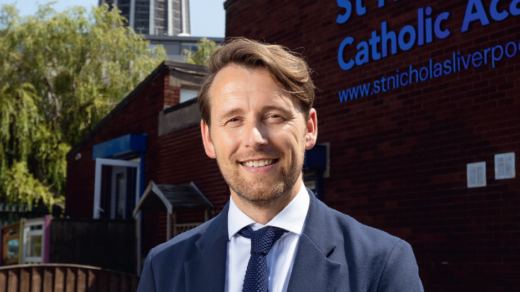
For James King, leading a primary school in the heart of Liverpool has brought his career almost full circle. Having grown up and attended primary school just a stone’s throw from where he now works, he understands first-hand the influence that a great teacher can have, not only on a child’s education but on the wider community around them.
“My own school experience really inspired me,” he says. “I honestly had some fantastic teachers in primary school. When you think about the difference they made and the way they became part of the community – they didn’t live there, but they were part of it.”
Their influence extended far beyond the classroom. James still talks to childhood friends about certain teachers, including Mr Kennedy and Miss Berry.
He adds: “I would often think, ‘We can make that difference for somebody.’ That was the main thing that got me into teaching.”
His career began in a Catholic primary school, where he also met his future wife, before spending six years at St Luke’s Catholic Primary School in Prescot. Working with headteachers who had very different approaches to leadership helped shape his own philosophy.
“They both had fantastic styles, but they were very different,” he explains. “It was about looking at those two different styles and thinking, ‘Okay, let’s merge something together.’”
When the opportunity arose to join St Nicholas as deputy headteacher, the school immediately felt familiar.
“What attracted me initially, and sounds very clichéd, was that it felt like coming home,” James continues. “It was a neighbouring school to the school I went to, so it felt like I was coming full circle and giving back.”
After joining as deputy headteacher, things moved more quickly than he had anticipated. When the existing headteacher left, James stepped into the role on an acting basis before subsequently applying for the permanent position and being appointed.
James’ enthusiasm for the school’s city-centre location is immediately apparent. Surrounded by universities, colleges and businesses, with Liverpool Metropolitan Cathedral on its doorstep serving as the school’s church, he sees the city as an extension of the classroom.
The potential is unreal,” he says. “We haven’t tapped into all of it yet, but we’re on our way. One big thing about being a headteacher is realising that everything can’t happen as fast as my head wants it to. Things take time.”
The school is developing links with organisations across the city, while its location means pupils can access experiences that might require significant transport costs for schools elsewhere.
“We have a massive opportunity to expose the children to so many different professions,” he explains. “We can show the children what is possible.”
While aspiration is central to his vision, one word that continually returns when James talks about St Nicholas is belonging.
“I’m very community-based from my own experience,” he explains. “I don’t want us to become a school of convenience. I want us to become a community school. I want people to feel like they belong.”
For a city-centre school, community does not necessarily fit the traditional model of a school serving a neighbourhood. St Nicholas welcomes families from many backgrounds, with some staying for a relatively short time and others establishing much longer connections.
The aim, however, is for every family to feel part of the school for however long they are there.
That has involved opening St Nicholas further to parents and looking beyond its own gates for opportunities.
When a lack of suitable grounds meant parents had been unable to attend a traditional sports day for several years, for example, the solution was to approach a neighbouring organisation about using its green space. The result is a sports day families can once again attend.
The school has also developed links with local services, bringing organisations together at coff ee mornings, afternoons and community events so families can access support more easily.
The diversity of the St Nicholas community is one of its many defining characteristics. Its pupil numbers can change considerably within a single academic year; in one year group, around 65 per cent of children changed over the course of the year.
“It can be difficult to measure impact in the conventional way because of the transient nature of the school, but the progress we see in the children is incredible,” James shared.
Many pupils arrive learning English as an additional language, bringing languages, cultures and experiences from around the world. The headteacher is particularly keen that multilingualism is recognised for what children already possess rather than what they may initially lack.
“We talk about how much we would love to be able to speak another language, so we need to recognise what these children already bring with them,” he says. “They may arrive without English, but that doesn’t mean they arrive without language.”
The resilience of some pupils is equally remarkable.
“Some of the things these children have been through really puts life into perspective,” James continues. “I’m 42, and some have experienced things I’ve never experienced in my life. Yet they come back into school the next day ready to learn.”
Families are encouraged to share their languages, cultures and faiths through school activities and diversity events.
One of James’ proudest achievements came earlier this year when St Nicholas welcomed around 60 new pupils and their families, following the closure of a local school.
Rather than gradually introducing the children over several weeks, the school decided to embrace the transition together. Families attended an open evening, met teachers and visited classrooms, before being given the option to start almost immediately.
“We basically said to the parents, ‘We have the space and, if you want your child to start tomorrow, they can start tomorrow,’” he recalls. By the first day back after Easter, all the children had joined St Nicholas.
The process placed considerable demands on staff, and James remembers standing with his exhausted team at the end of one particularly long evening and finding an unexpected phrase to describe what was happening.
“I said, ‘Guys, thank you. This is the beginning of beautiful chaos.’”
A few weeks later, the chaos had settled.
“It was chaotic for a little while, but then it became something really beautiful. Everyone embraced it,” he says.
While James is proud of what has been achieved at St Nicholas, he is equally keen to acknowledge the support he has received during his first year of headship. In particular, he credits St Joseph Catholic Multi Academy Trust and the director of primary education, Amy Fidler, and fellow headteachers with helping him navigate the transition into the role.
“As a new headteacher, the support from the trust has been second to none,” he says. “You don’t feel like you’re alone.”
That support also extends beyond the trust to the wider network of headteachers across the area.
“One of the biggest pieces of advice I would give is: don’t become insular,” James explains. “Open yourself up to other schools, find out what they’re doing and learn from them.”
It is an approach that reflects the same love of learning he wants to instil in the children at St Nicholas: becoming a headteacher has not meant having all the answers, but knowing when to ask questions and who to learn from.
Ultimately, James’ ambitions for St Nicholas extend well beyond academic outcomes.
“We want the children who leave our school to be good people,” he says. “We want them to leave still wanting to learn more and to develop that love of learning that will stay with them forever.”
James hopes pupils will continue to value friendships, respect others and appreciate different cultures and faiths. Equally, he wants the teachers at St Nicholas to understand the influence they can have on a child long after they have left their classroom.
It brings the conversation neatly back to the teachers who first inspired his own career.
“I started this interview by talking about Mr Kennedy, and that’s what I want for our school,” James concludes. “I want to be somebody’s Mr Kennedy, and I want our teachers to be somebody’s Mr Kennedy. I want children to look back and say, ‘That teacher made a big difference to my life.’”
For a headteacher whose career has brought him back to the community that shaped him, it is a fitting ambition. Having been inspired by his own teachers, he now hopes another generation will leave St Nicholas with the same sense of belonging and possibility.