
National pilot scheme with Wirral school trust hailed a great success
 by Educate Magazine March 3, 2026 · All News / Multi Academy Trust News
A national pilot by the Creativity Collaboratives research programme has evidenced the transformative power of teaching for creativity in the classroom and beyond.
C Change is the only North West collaborator within the Creativity Collaboratives. It was proudly formed by Holy Family Catholic Multi Academy Trust (HFCMAT) and led by St Bernard’s RC Primary and Nursery School in Ellesmere Port. It has piloted a range of innovative, creative-focused teaching approaches across its 11-school network. Results demonstrated significant improvements in engagement, confidence and autonomy.
C Change recognised that creativity can only be embedded when schools develop it at scale. In response, the team created a framework that helped schools drive significant innovations. Pupils, teachers, leaders and the wider community all felt the impact.
Transformative impact on pupils
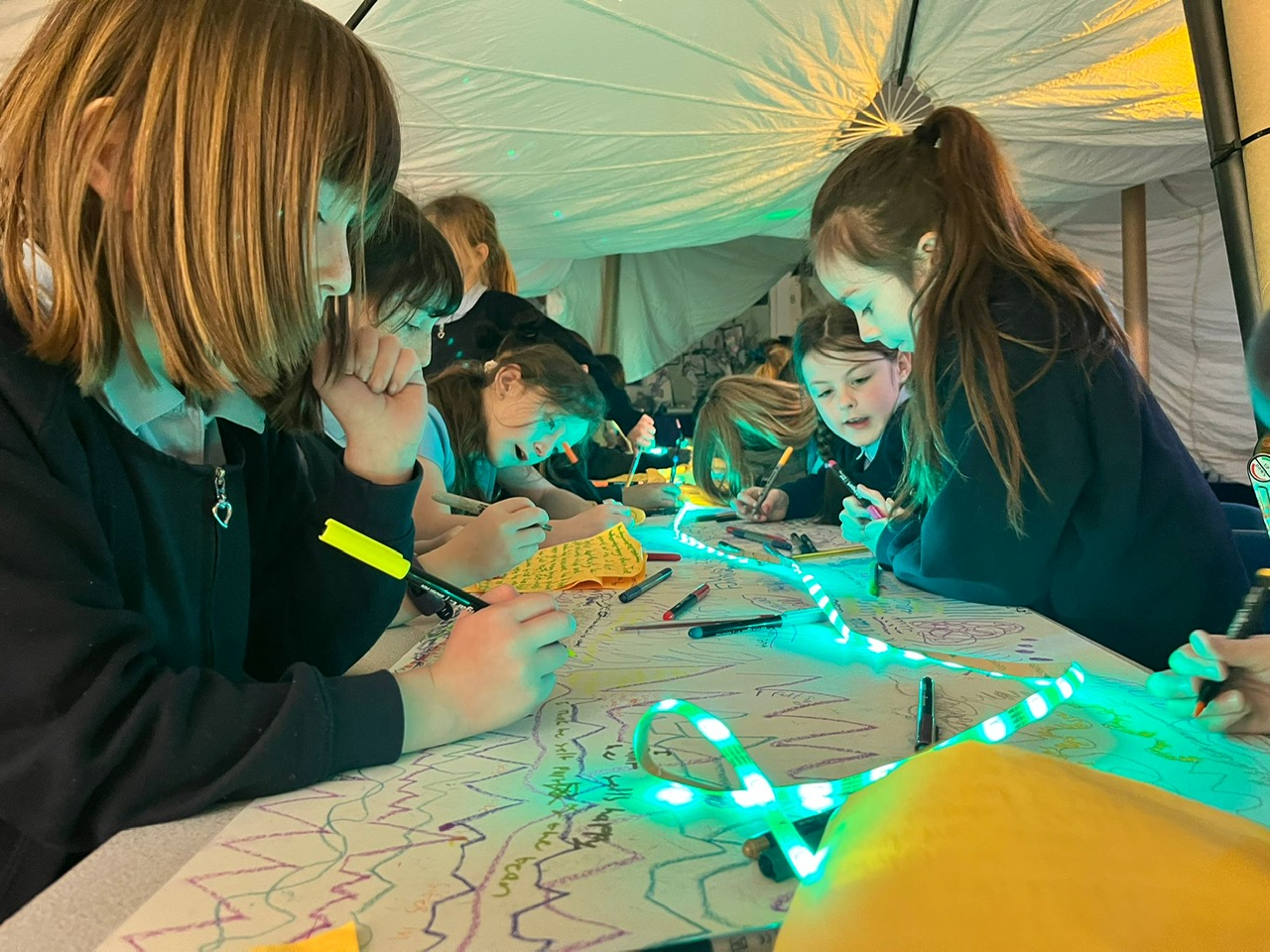
Pupils experienced increased confidence and resilience, improved pride and self-esteem, became self-aware as learners and took ownership of their learning.
During the pilot, one pupil reflected:
“When teachers asked us in English to do creative writing, I used to always struggle – the further I progressed the more I lost control of the story. But now, as we have learnt what creativity means, I think I could like creative writing. I know I can now write for longer and persevere.”
Empowering teachers and leaders
The skills and confidence of teachers and leaders have grown under this project. They developed an increased sense of agency and autonomy within the classroom, leading to a positive shift in culture and ethos, and the development of a shared language.
Discussing their shift in confidence using the creative habits, one teacher noted:
“I feel more equipped to use strategies that without being part of the research cycles, I would not have had the confidence to use.”
Emily Reid, C Change project lead and assistant headteacher at St Bernard’s RC Primary and Nursery School, said:
“Over the past five years, we have been proud to lead C Change and support a network of schools to explore the impact of creative thinking in the classroom and beyond. We have seen first-hand how creative thinking has increased pupil confidence, resilience, collaboration skills and an understanding of themselves as learners.
“The partnerships we have developed through this work, with organisations like Theatre Porto, Chester Zoo and Focal Studios, have transformed the educational experiences for our young people.”
C Change’s dynamic partnership work with local businesses, academic institutions and community organisations has significantly extended pupils’ educational experiences beyond the classroom.
Celebrating culture and creativity
Through Wirral’s Borough of Culture programme, pupils have contributed to large-scale civic celebrations. They have also curated and performed in a growing arts festival, showcasing visual art, music, dance and spoken word developed in collaboration with creative professionals.
In New Brighton, place-based work with Rockpoint and Focal Studios has has opened up new opportunities for young people. It has enabled them to engage directly with the creative and digital industries. This work is helping them understand how culture drives regeneration.
Alongside taking over Chester Zoo as zoo rangers and completing work experience with cultural and creative organisations, these opportunities are equipping pupils with cultural capital, enterprise skills and a strong sense of belonging within their community.
Impact on communities and organisations
The connections created during the pilot had a profound impact on pupils and teachers. Partner organisations have revitalised their culture, and communities have regenerated. Creative thinking is now a shared language across schools and employers.
One partner commented:
“Now, we have a foundation and framework to create an education pipeline.”
About the C Change network
C Change was one of eight regional networks formed as part of the Creativity Collaboratives. It incorporates five HFCMAT schools (St Bernard’s RC Primary and Nursery School, Our Lady of Pity RC Primary School, St Mary’s Catholic College, St John Plessington Catholic College, and St Joseph’s Catholic Primary School), as well as Everton Nursery and Children’s Centre, Everton Free School, Hinderton School, Parklands Community Primary School, Kelsall Primary School, and The Oaks Community Primary School.
Andy Moor, CEO of HFCMAT, said:
“At Holy Family Catholic Multi Academy Trust, we believe creativity flourishes when schools work in true partnership. With the launch of the white paper this week, the focus around collaborative learning ecosystems reinforces what we have long championed, that opportunity expands when education connects meaningfully with culture, business and community.
“Through C Change, we have seen how creative partnerships open doors for young people, broaden aspirations and build the confidence to contribute to their place. By working together across our network and with wider partners, we are not simply enriching education; we are shaping an ecosystem where every child can access experiences that inspire, challenge and transform their future.
“Congratulations to Emily and the team for the remarkable work they have delivered as part of C Change, the impact of which has already, and will continue to, make such a difference to primary pupils, secondary students, teachers and leaders across the North West.”
National findings and recommendations
The Creativity Collaboratives programme emerged from the recommendations of the Durham Commission on Creativity and Education. It is led by Durham University in partnership with Arts Council England and promotes the idea that educators should nurture creativity across all subjects and school settings.
More than 4,400 primary pupils, 1,300 secondary students, 500 teachers and 100 senior leaders took part in the independent evaluation of the programme. It recommends that the model should be retained with minimal change if rolled out nationally.
Dr Helen Cramman, associate professor at Durham University’s School of Education who co-authored the evaluation report, said:
“We found that the Creativity Collaboratives is a model that works. It shows that when schools collaborate to focus on teaching for creativity – working in partnership with creative practitioners and universities – teaching becomes more reflective and engaging for pupils as well as the teachers.
“Through our extensive evaluation, we found that teachers felt re-energised, pupils were more engaged, and school communities grew stronger as a result.”
Read C Change’s report here.
Read the national Creativity Collaborative’s programme evaluation report here.